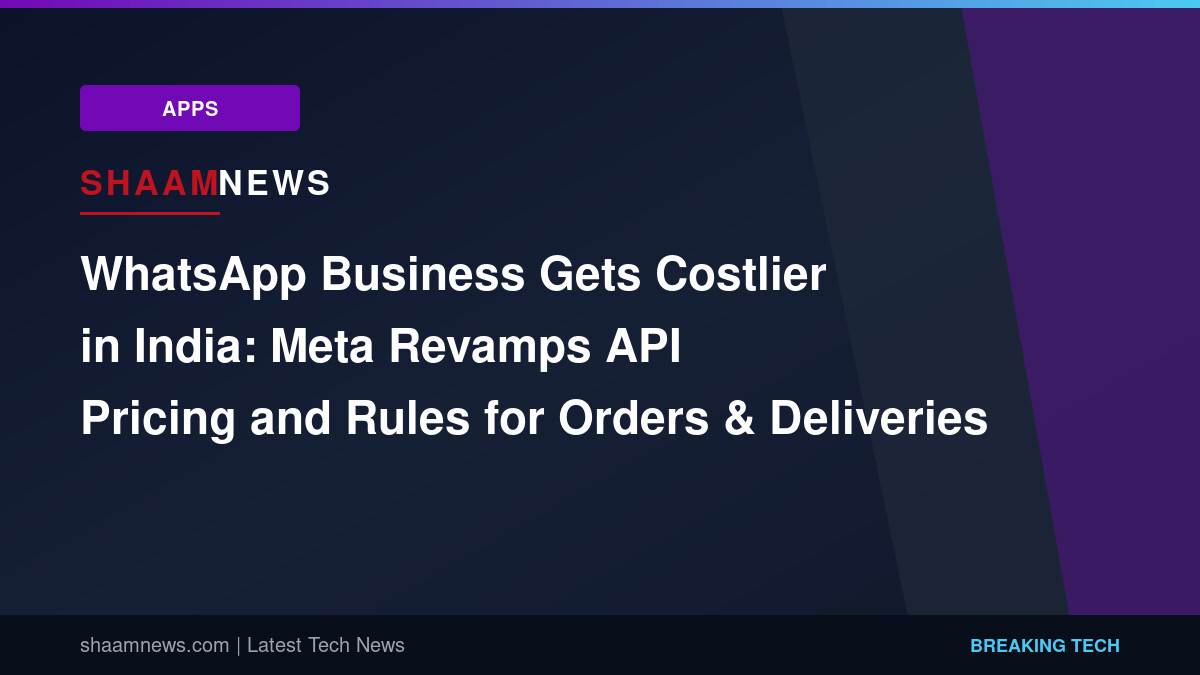
- Meta has restructured conversation-based pricing and notification rules for the WhatsApp Business API.
- Automated order confirmations and delivery updates are now more expensive for Indian SMEs and D2C brands.
- The updated policy went live on October 1, compelling companies to re-evaluate their customer communication budgets.
WhatsApp has cemented its position as India’s default digital communication lifeline for commerce. However, conducting business on the platform just got more expensive. Meta has officially rolled out a comprehensive revision of its WhatsApp Business API pricing structure and conversation guidelines. For Indian e-commerce brands, direct-to-consumer (D2C) startups, and service aggregators relying heavily on automated workflows, these changes directly impact monthly operational expenditures.
In this comprehensive ShaamNews tech explainer, we dissect the financial and operational implications of Meta’s latest policy shift for Indian businesses, evaluating how enterprises can optimize their outreach without breaking the bank.
While Meta’s revised pricing adds a layer of operational cost, WhatsApp’s unmatched engagement rates in India still justify the investment over traditional SMS. However, businesses must eliminate spammy broadcasts and focus strictly on high-intent interactions.
7.5/10
9.5/10
9.0/10
8.5/10
Dissecting Meta’s Revised API Pricing Structure
Meta’s conversation-based pricing model has been further fine-tuned across distinct categories: Marketing, Utility, Authentication, and Service. In India, where businesses leverage WhatsApp for every touchpoint—from cart abandonment recovery to live delivery tracking—changes in the ‘Utility’ and ‘Marketing’ tiers carry substantial weight. Companies that previously deployed indiscriminate bulk messaging will find their profit margins squeezed under the stricter rate slabs.
Industry analysts note that while transparency has improved with category-specific pricing, the net effect is inflationary for mid-sized enterprises. Brands must now treat every chat window as a calculated investment rather than a generic broadcast channel.
The financial pressure is acutely felt in the e-commerce and logistics sectors, where sending automated dispatch alerts, shipping updates, and delivery OTPs is mandatory. Indian consumers expect real-time WhatsApp notifications at every single milestone of their order journey. Brands cannot afford to drop these notifications due to customer experience expectations, forcing them to absorb the higher API fees.
| Feature / Specification | New Meta API Framework | Pre-October Standard | ShaamNews Verdict |
|---|---|---|---|
| Pricing Architecture | Granular Category-Based Slabs | Standard Bulk & Chat Rates | More transparent, but net costlier |
| Utility Messages (Orders) | Revised & Slightly Higher Slabs | Standardised tier | Adds 10-15% to operational overhead |
| Marketing Conversations | Dynamic Category Pricing | Fixed per-message charge | Demands highly targeted campaigns |
| Impact on Indian SMEs | Moderate to High Financial Strain | Minimal friction | Urgent need for workflow optimization |
- Strict penalties on spammy broadcasts will improve overall consumer trust.
- Clearer category delineation helps in precise marketing budget allocation.
- End-to-end encryption and high deliverability rates remain unmatched.
- Increased utility message costs burden low-margin Indian SMEs.
- Managing API integrations remains technically challenging for smaller local retailers.
Ultimately, finding an equivalent substitute for WhatsApp in the Indian consumer ecosystem remains virtually impossible given its ubiquitous penetration. Enterprises must adapt by sharpening their automation flows, cutting redundant broadcasts, and doubling down on high-value user interactions.
Read the original news source here: Jagran News
*Always download from official app stores. Avoid unverified third-party APK sources.
Join the official ShaamNews WhatsApp Channel for daily gadget launches, reviews, and deals.
About the Author